Walk-forward validation: keep tomorrow out of training
Design a chronological research process that evaluates the whole decision procedure rather than a polished historical rule.
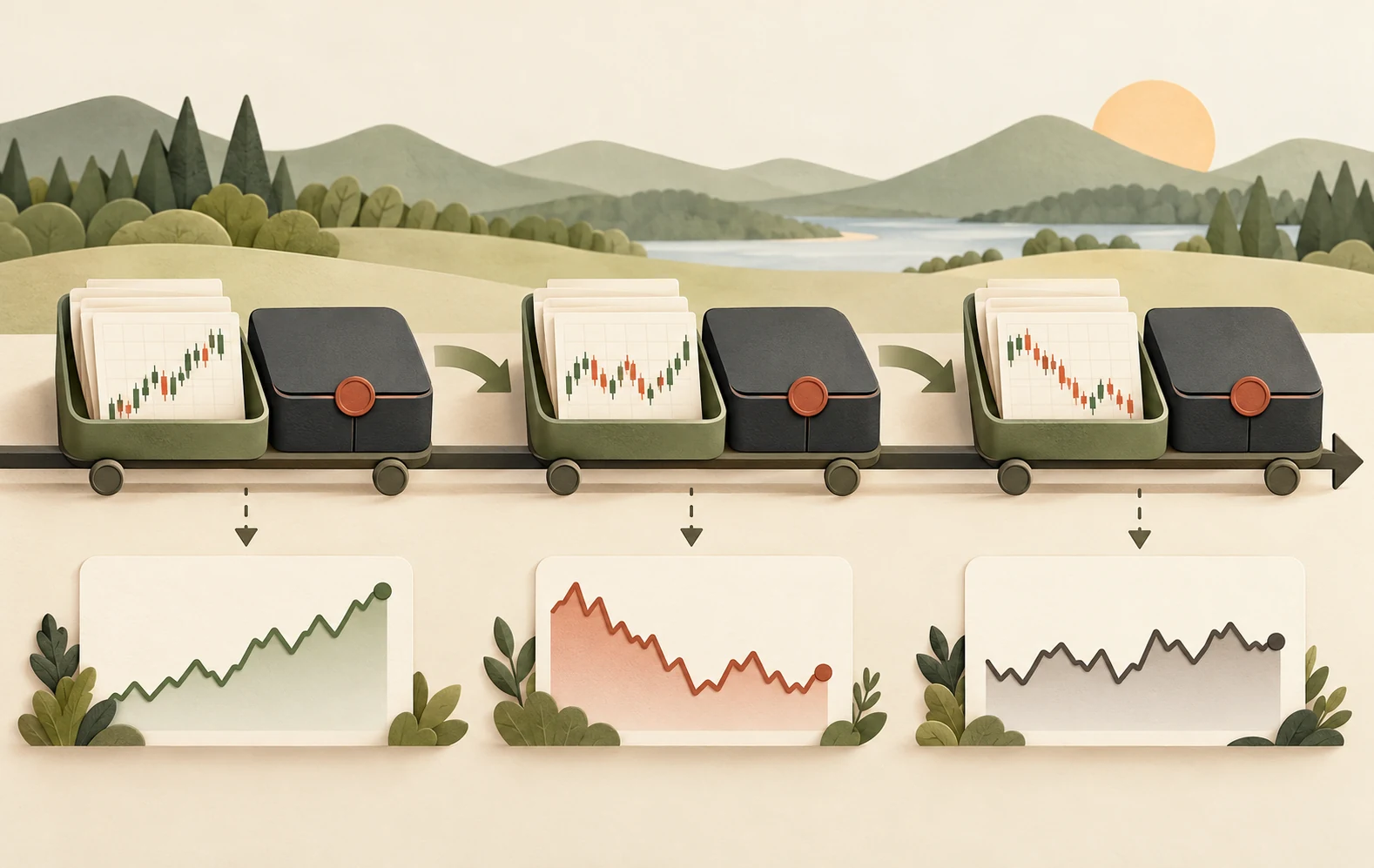
Test a process rather than a final formula
A walk-forward study repeatedly fits a model using information available at a historical date, freezes the resulting decisions, and evaluates them over a later interval. The sequence then advances. This imitates a research process that must operate without future knowledge. It does not make a strategy profitable or eliminate all bias.
Write down what is allowed to change at each step. Signal parameters, asset selection, volatility estimates and cost assumptions are all parts of the procedure. If the researcher manually adjusts these after seeing a test period, the procedure has changed and that period is no longer a clean assessment. A reproducible schedule is more informative than a chart assembled from discretionary revisions.
Choose rolling or expanding history deliberately
An expanding window retains all earlier observations as time advances. It can stabilize estimates but also retain data from obsolete market conditions. A rolling window uses a fixed recent span, making adaptation easier while increasing sampling noise. Neither approach is universally superior; the relevant trade-off depends on what economic relationship is expected to persist.
Choose window lengths for a defensible reason before comparing results. Trying dozens of lengths and selecting the best simply moves optimization to a higher level. Record the number of observations, distinct market episodes and actual trades in every test interval. A long calendar span with very few independent decisions may provide less evidence than its duration suggests.
Leakage hides in data preparation
Chronological splitting is necessary but not sufficient. Standardizing a feature with the full sample's mean lets future observations influence past inputs. Selecting surviving securities, using revised macroeconomic figures or incorporating a filing before its publication time produces other forms of hindsight. Fit transformations on training data and preserve as-of availability wherever possible.
Labels also matter. If a training example predicts a return measured over the next five days, its outcome can overlap the beginning of the test period. Remove or separate observations whose label windows cross the boundary. Software can insert a gap between train and test indices, but choosing a meaningful gap requires understanding label horizons, publication delays and dependence in the particular dataset.
Separate an observation’s feature date from the date its outcome becomes known. A signal formed on Monday may use only Monday’s available inputs, yet its five-day return label is not known on Tuesday. A refit on Tuesday cannot legitimately train on that completed label. The eligibility rule must therefore check the full label interval and data availability, not merely whether the row’s first timestamp precedes the training cutoff. Publication delays can require additional separation beyond the nominal holding horizon.
Tune inside training, preserve an untouched evaluation
Parameter selection should occur using only information inside the training region, potentially through an inner chronological validation procedure. The outer test interval then evaluates the selected procedure. This nesting distinguishes choosing a model from measuring how the choice performs. It also makes the computation more expensive, which is preferable to obtaining a cheap but contaminated result.
Aggregate the sequential test returns in their real time order, including periods with no position. Apply fees and execution assumptions consistently. Do not average attractive fold-level ratios without inspecting their economic meaning: a small quiet interval can otherwise receive the same apparent importance as a long volatile one. Show dispersion across intervals alongside the combined result.
A weak result is usable evidence
Walk-forward performance that deteriorates after costs, depends on one interval or changes dramatically with a minor timing adjustment deserves investigation rather than cosmetic repair. Separate a data or implementation defect from a strategy that simply lacks support. Fixing a genuine bug can justify a new run, but the earlier exposure to results must remain part of the research history.
Finish with a frozen specification and a genuinely new paper-observation period if further evaluation is warranted. Predefine what data will be collected and what would invalidate the assumptions. The purpose is not to keep optimizing until an attractive line appears; it is to establish whether a disciplined, implementable procedure survives opportunities to fail.
Carry the portfolio across validation boundaries
A model refit is not automatically a liquidation event. Suppose a January–March test interval ends with an open position whose original rule exits in April. At the March boundary, decide whether the position follows its original exit rule, adopts a documented new rule, or is closed with costs. Resetting each fold to cash without recording that close can erase losses, invent available capital or avoid a difficult transition. The validation process needs a policy for existing holdings as well as a policy for new predictions.
Capital must also flow through the combined test. If one test interval returns 10% and the next loses 10%, sequential wealth grows by 1.10 × 0.90 = 0.99, a net loss of 1%. Averaging the two returns to zero does not reproduce the account. Preserve chronological daily or trade-level returns under a consistent funding and sizing convention, then calculate aggregate metrics from that sequence. If folds overlap in calendar time, do not count the same account return twice; specify which model controls each decision or how concurrent models share capital.
Model selection belongs inside each training cutoff, including feature selection, scaling, imputation and the choice among candidate algorithms. A transformation fitted once on the entire dataset remains contaminated even when the final estimator is refitted honestly. The scikit-learn TimeSeriesSplit interface provides chronological splits and an optional index gap, but it does not know when a financial label matures, whether a filing was revised, or how a live position should cross a fold boundary. Those are responsibilities of the research design.
Keep a fold ledger with the training endpoint, eligible observations, chosen specification, first executable test timestamp, starting holdings, costs and final holdings. Add a reason for every skipped observation or trade. This makes an apparent performance collapse traceable: perhaps the mechanism weakened, perhaps the training sample changed, or perhaps the process handled a boundary incorrectly. If a boundary bug is corrected, rerun the procedure consistently and retain the earlier result as part of the research history rather than presenting the correction as an untouched experiment.